Tuesday, January 21, 2014

You All Meet in a Tavern...

The Epistle lesson for this Sunday feels out of place to me in relation to the rest of the lectionary readings, but I was really struck by it when I read it for several reasons.  The first reason is that the quote from Felicia Day (as reported by Wired) that I talked about last week was still very much in my mind:
“We have to mean something ourselves, and not just get trapped into, ‘Hey, everything’s just a mashup T-shirt,’” Day says in Episode 91 of the Geek’s Guide to the Galaxy podcast. “The substance of what it means to be a geek is essentially someone who’s brave enough to love something against judgment. The heart of being a geek is a little bit of rejection.”
In order to keep your sanity as a Christian you absolutely must love against judgement—we have to understand that there will always be at least a little bit of rejection at the heart of being a Christian.  This is something that modern Christianity—especially in the United States—has forgotten.  Very broadly, it went something like this: people flocked to the church in the midst and the wake of World War II and taught their children the importance of their faith.  When their children grew up, they taught their own children to go to church because it's expected of us and because I told you to, that's why.  So we've had about two and a half generations of people for whom morning worship was simply what was done on Sunday.  Now those generations are looking at those of us who came after and wondering why they can't see that they're just plain degenerate for not showing up to worship.

Don't worry, I'm not going to get into a huge discussion of the "spiritual but not religious" crowd.  Not this week anyway.  But I will say this—the other reason I was struck by the Epistle lesson was that it shows that the problems "spiritual but not religious" folk have with organized religion have always been there.  "For it has been reported to me by Chloe's people that there are quarrels among you, my brothers and sisters."  Church people have always been quarreling with each other and they have always been claiming that their own "brand" of the faith is superior to that of their neighbor.  Paul responds by reminding them that "...the message about the cross is foolishness..." to the rest of the world.  So why spend a lot of ultimately negative energy fighting about who's better than whom?  There will always be some rejection at the heart of being a Christian.

I don't see much, if any, of that theme in the Gospel lesson or the Hebrew lesson(s) it alludes to.  Instead I keep coming back to what the common expectations of what the Messiah was going to be like when Jesus was born, grew up, and served out his ministry on earth.  Remember that Israel had been conquered by the Roman empire.  Herod the Great (famous for spending lots of money to tear down the temple in Jerusalem to build it again—only bigger—and for being a completely ruthless bastard) and his successor and son, Herod Antipas (famous for executing John the Baptist, his role in the execution of Jesus, and for divorcing his wife so he could marry his brother's wife—yes you read that right) were named "King of the Jews" by the Roman Senate and Caesar Augustus, respectively.  So when people talked about a savior, a Messiah, an "anointed one," they were thinking of a political and military hero.  They were imagining the next King David—a true "King of the Jews" who would come to kick butts and chew bubblegum...  and he'd be all out of bubblegum.  So when Herod Antipas has John the Baptist beheaded for running his mouth—John was appalled at the whole divorcing his wife so he could have his brother's wife thing—and Jesus began preaching that the Kingdom of God was at hand and started gathering people to him...  Well, it kind of feels like the beginning of a fantasy novel or a Dungeons & Dragons campaign.  The hero of the story starts building his party, right?  A hearty band of adventurers who will rise up against the evil empire and destroy it!  Actually, that sounds more like Star Wars, but you get the point.

Of course, Jesus doesn't turn out to be that kind of King.  Only one member of the party died and stayed dead in that campaign.  Oh, and every single one of them wanted to play the cleric!  That's not to say that Jesus wasn't fighting for something—it just turned out not to be that kind of fight.  Forming up his adventuring party was no small thing.  Rich and poor and middle class, his disciples dropped everything they were doing, left their jobs and their families, and their lives behind to follow Jesus.  And he may not have led an armed revolution, but the things he was preaching... well, they all came from his understanding of the Hebrew Bible, but they were still revolutionary!  There was a lot of what we would call "economic justice" today in what Jesus taught.  The kinds of things that Pope Francis has been saying‐the kinds of things that have been ruffling the feathers of wealthy Americans.  That message and the reaction it has been receiving is perhaps best summed up in the words of Dom Helder Camara, "When I feed the poor, they call me a saint, but when I ask why the poor are hungry, they call me a communist."

Talk about the message of the Cross being foolishness to the world!  Talk about rejection being at the heart of what it means to be a Christian!

Huh.  Maybe that earlier theme was in there after all...

Be good to each other,
Rev. Josh
012114

The scripture lessons for January 26th—The Third Sunday after Epiphany Year A—are:

Tuesday, January 14, 2014

The Big Bang Theory

There are actually several great theological themes in the scripture lessons for Sunday, but this week I'm especially drawn to the concepts of call (or vocation, if you will) and—believe it or not—evangelism. Basically the idea of having a calling or vocation is that God has given you certain gifts—certain talents—and that the appropriate response and the perfect "thank you" are to use those gifts in the most faithful way possible.  Sometimes it's really obvious when someone has found their calling and are using their God-given gifts to their fullest potential.  Just off the top of my head I think of Fred Rodgers, Mother Theresa, Jim Henson, Nelson Mandela... you get the point.  Sometimes it's not as obvious, like when your car mechanic doesn't sabotage your vehicle to ensure future business. The point is to use your gifts for the benefit of all—and that's something that shows, whether or not your light is shining on the world's stage or just in the local garage.

The word "evangelism" has come to be associated with stuff that makes a lot of people—even ordained clergy!‐really, really uncomfortable. For some it simply brings to mind folk knocking on the door and imploring you to read a copy of The Watchtower or The Book of Mormon.  For others it evokes brands of fundamentalist theology that believe they have the only correct answers to life's questions and that any other answers are one-way tickets straight to hell.

And that's sad.  Because evangelism is about being so excited about your own path that you simply have to tell other people about it.  There are plenty of truly awesome and righteous religious paths out there, and I find it deeply tragic that such a small handful of them have the reputation for wanting and needing to share how awesome and righteous they are with the rest of the world.

I think this is a place where Christianity—especially local mainline churches—could learn a lot from geek culture.  The first thing that springs to mind for me is one of my favorite quotes from Felicia Day (as reported by Wired):
“We have to mean something ourselves, and not just get trapped into, ‘Hey, everything’s just a mashup T-shirt,’” Day says in Episode 91 of the Geek’s Guide to the Galaxy podcast. “The substance of what it means to be a geek is essentially someone who’s brave enough to love something against judgment. The heart of being a geek is a little bit of rejection.”
That first part, by the way, strikes me as getting at the idea of vocation—we have to mean something.  Maybe that's something that Christianity could be helping geek culture with while geek culture helps Christianity with that second part.  Even if it means a little bit of rejection, we have to love the path we're on against judgement.

The second thing that comes to me—the best popular culture example of what I want to get at here—is The Big Bang Theory.  Now, I have to say that I—like many geeks—have a love/hate relationship with the program.  But that's probably its own post at some point.

For now I want to uplift one of the things that keeps me watching.  The fact is that the program came out of a marriage between two different show ideas:  The first was about these two genius roommates—the kind of people who's thoughts and work change the world, but who simply can't relate to the rest of us in socially acceptable ways.  The second was about this naive country girl moving to the big city to try to break into acting and ending up as a waitress.  Combining these two things into one show mean that all the tension and comedy—the story, in other words—come out of the meeting of these two worlds.  One of the things I love about the series is that when those worlds meet each other, they affect change in each other.

One of the ways these two genius geeks affect change in this Nebraskan wanna-be actress is through that substance of what it means to be a geek that Felicia Day identified.  What they love they love with reckless abandonment—all the stereotypical geeky things, from D&D to comic books—despite all the snarky comments she could throw at them.  And the cool thing is that their obvious love of these things does draw her in.  The love all these things so much that their response to her making fun of them is to say (echoes of Jesus in the Gospel lesson for Sunday) "Come and see."  Sit down and watch Star Trek with us.  Come to the comic book store with us.

Christianity in general, and local mainline churches specifically, need to ask themselves if they're so excited about the path they're on that they would love it despite the judgement of their neighbors.  Do they love their path so much that they "geek out" over it?  Are the excited enough about their path that they simply can't help saying "come and see?"

Be good to each other,
Rev. Josh
011414

The scripture lessons for January 19th—The Second Sunday after Epiphany Year A—are:
Sunday, January 5, 2014

Epiphany

Monday, May 20, 2013

In My Restless Dreams I See That Town...


Sometimes people find it strange that I have a real love for horror.  Poetry, prose, graphic novels, film  television, tabletop games, video games—it doesn't matter, I like them all.  I think folk get surprised because they assume that someone as holy as an ordained minister shouldn't be thinking about dark things.  "After all," they misquote Nietzsche, "Stare not into the abyss, lest the abyss stare into you!"  Actually, what he said was, "Whoever fights monsters should see to it that in the process he does not become a monster.  And when you look long into an abyss, the abyss also looks into you."  To be honest, that's exactly the kind of thing that everyone—but particularly ordained ministers—should think about every so often.

Besides, if I told you about a book where one of the main characters went about killing men and collecting their foreskins, wouldn't you assume that I'm talking about a particularly sick horror novel?  Unless, of course, you know more about the story of King David than most people can honestly claim.  Then you'd know I was talking about the Bible.  The truth is, there are some truly horrific things in the Christian tradition. And tales of horror are basically stories about good vs. evil.  So I don't see any harm in an ordained pastor being into that kind of thing.

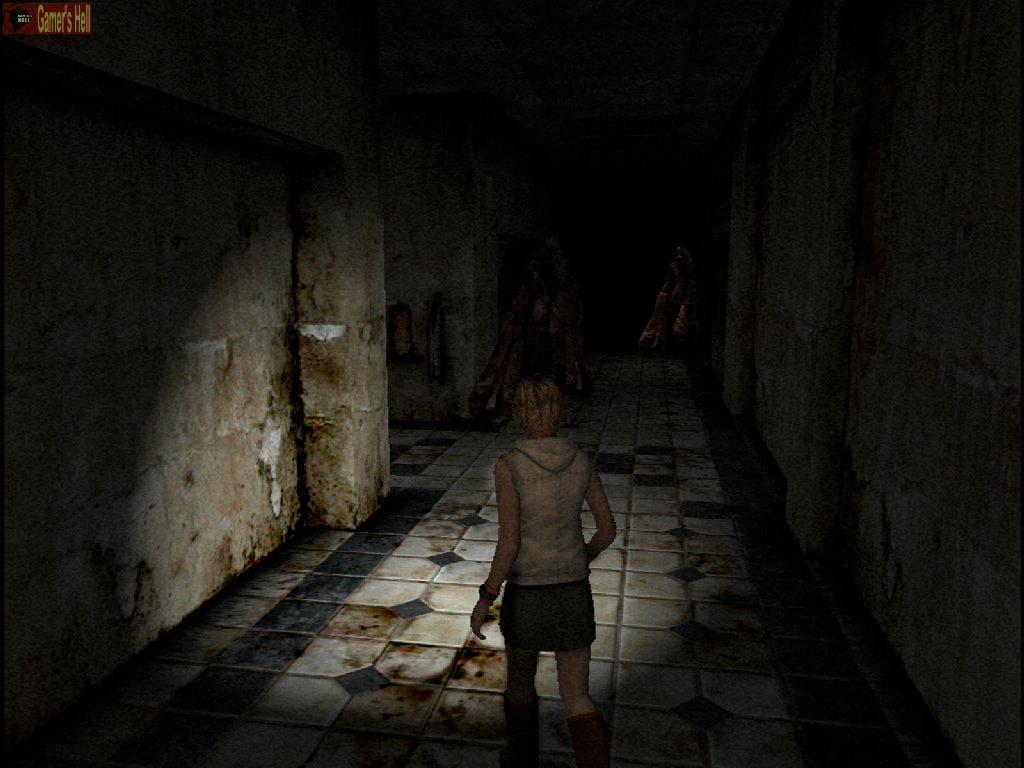
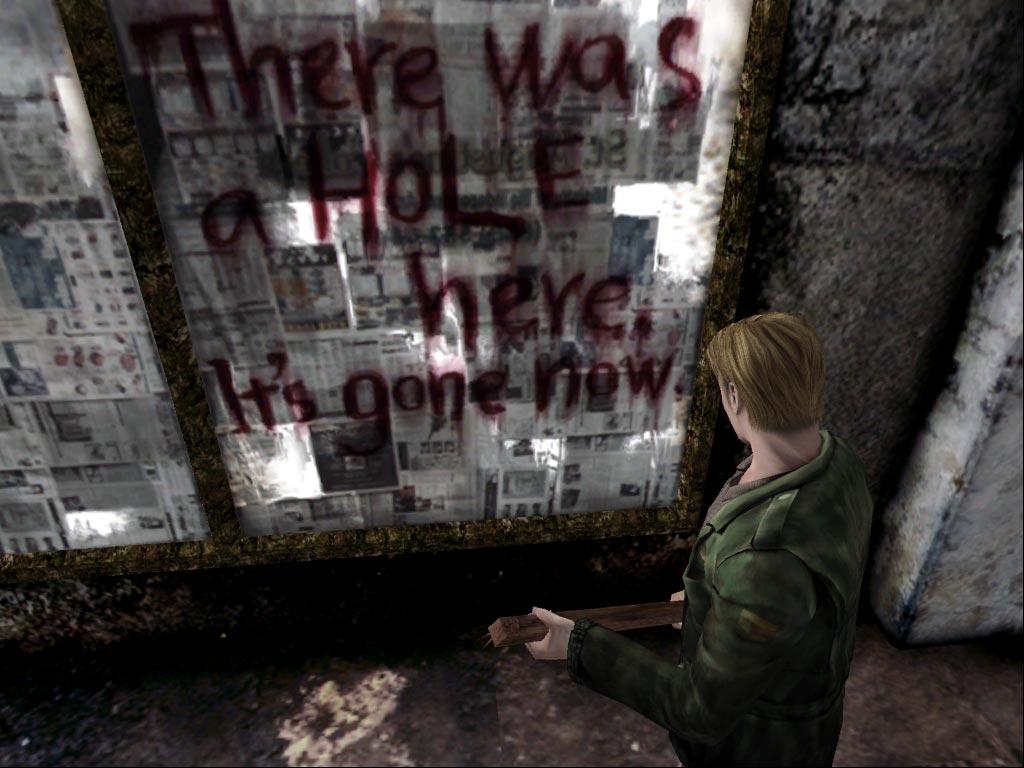
One of my favorite horror settings is Silent Hill.

Silent Hill started off as a video game in a sub-genre of action/adventure known as survival horror. There's definitely enough story in these games to keep me playing. Of course, there were nights where playing in the dark with the surround sound on discouraged me from sleeping. Again. Ever. But it's all in good fun, right? It's really little environmental things that caught me with the Silent Hill games. Like searching through a decrepit and abandoned public restroom and listening to the main character knock on a stall door-- and being answered, once, with a return knock.

BANG


And knock as much as you like after that, you can't get it to repeat. You just never know when something like that is going to happen. The monsters you fight are almost secondary. Almost. The monsters are seriously disturbing too. Imagine meeting one of these nurses in an abandoned hospital... *shiver*

Silent Hill has done well enough critically to warrant a feature film, now available on DVD. If you aren't into gaming but want to find out what the feel of the story and the environment are, I suggest you rent it. Then watch it with the lights out and the surround sound on.

Go on. I dare you. Find out why anytime I find myself someplace truly creepy, I can't seem to keep from  saying, "Welcome to Silent Hill."  Even when I'm alone.

I once wrote that life is like Silent Hill sometimes.  Granted, that was a particularly difficult time in my own story, but I think that the lessons I learned from playing—and being scared by—the Silent Hill games might still be right on.  So when things get overwhelming, just remember the following things:

Sometimes you're in a dark place.


Sometimes you can't go the way you used to.


Sometimes there are barriers in your way.


Sometimes there's something scary between where you are and where you need to be.


And yet, even though sometimes it may be circuitous, counter-intuitive  hidden, or just plain hellish, there's always a way forward.


Be good to each other,
Rev. Josh
052013

Monday, April 29, 2013

Take Your Stinkin' Paws Off Me!

In the post entitled “Murder Simulator?” I mentioned that there’s “some great theological stuff around the Monkeysphere and Jesus' answer to that whole thing…” and that I might do a post just around that somewhere down the road.  Well, I guess we’re somewhere down the road, because here it is!

Primatologists discovered that the size of a primate’s brain determines the size of the social groups that primate forms.  In other words, the bigger the brain, the bigger the society they form.  An anthropologist named Robin Dunbar says that the same is true for you and me.

Author David Wong explains it this way.  Imagine a cute little monkey.  He suggests that you imagine that he’s dressed up like a pirate and that you have all kinds of monkey pirate adventures.


I feel compelled to admit that the pirate outfit and accompanying adventures are fun, but probably not necessary for this explanation.

He also says that you should name him Slappy and that you should image how much you love and enjoy Slappy’s company.  And that I do want you to do.  Because I want you to realize how sad you would be if Slappy died.

Now imagine that you get four more monkeys.  I won’t use the names that Wong suggests, so let’s call them Matthew, Mark, Luke and John.  Imagine that Matthew is affectionate, Mark is aggressive, Luke is quiet, and John loves sitting on the top of the grandfather clock and screaming.  But they’re all your pets, and you love them.

Now imagine that you get one hundred more monkeys.  Wong writes, “Not so easy now, is it? So how many monkeys would you have to own before you couldn't remember their names? At what point, in your mind, do your beloved pets become just a faceless sea of monkey?”  Well, if Dunbar is correct, the answer is about 150 monkeys.

That’s all our brains can handle.  About 150.

In his book, This Book Is Full of Spiders, Wong describes the problem this way:
“…everything we do requires cooperation in groups larger than a hundred and fifty.  Governments.  Corporations.  Society as a whole.  And we are physically incapable of handling it.  So every moment of the day we urgently try to separate everyone on earth into two groups—those inside the sphere of sympathy and those outside.  Black verses white, liberal verses conservative, Muslim verses Christian, Lakers fan versus Celtics fan.  With us, or against us.  Infected verses clean.  We simplify tens of millions of individuals down into simplistic stereotypes, so that they hold the space of only one individual in our limited available memory slots…”
Now, this problem is addressed all over the place in Judaism and Christianity and probably every other religion in the world.  But I’m a Christian, so I’m going to focus on two places that Jesus addresses it.  If you want to get into the text yourself, you can find these passages in Luke 4:16-30 and Matthew 25:31-46.  So, after Jesus was Baptized he was driven into the wilderness by the Holy Spirit.  He overcame temptation out there and then, still full of the Spirit, he began to preach and teach all around Galilee.

One day he came home to Nazareth and went to the synagogue there on the Sabbath.  He stood up and read a passage from the prophet Isaiah, “The Spirit of the Lord is upon me, because he has anointed me to bring good news to the poor.  He has sent me to proclaim release to the captives and recovery of sight to the blind, to let the oppressed go free, to proclaim the year of the Lord’s favor.”

But he chose to end the quote before he got to the part where Isaiah talks about the day of the vengeance of the Lord, and he rolled up the scroll, gave it back to the attendant, and sat down.

Then he began to say to them, “Today this scripture has been fulfilled in your hearing.”  All spoke well of him and were amazed at the gracious words that came from his mouth.  They said, “Is not this Joseph's son?”

I think that Jesus was trying to make a point when he read that passage from Isaiah.  Or rather, I believe that he was trying to make a point when he stopped in the middle of a verse.  The full verse is, “…to proclaim the year of the Lord’s favor, and the day of vengeance of our God…”  I think that Jesus was trying to steer the people away from the path of vengeance.

But I also believe that as soon as Jesus said, “The Spirit of the Lord is upon me,” the people remembered the whole passage and assumed that Jesus was going to the same place—the place where the people get their vengeance over their enemies.  Payback time.

And Jesus saw how the people approved of him and were amazed by him and… he kept talking.  “Doubtless you will quote to me this proverb, ‘Doctor, cure yourself!’  And you will say, ‘Do here also in your hometown the things that we have heard you did at Capernaum.’’  And he said, ‘Truly I tell you, no prophet is accepted in the prophet's hometown.  But the truth is, there were many widows in Israel in the time of Elijah, when the heaven was shut up three years and six months, and there was a severe famine over all the land; yet Elijah was sent to none of them except to a widow at Zarephath in Sidon.  There were also many lepers in Israel in the time of the prophet Elisha, and none of them was cleansed except Naaman the Syrian.”

What Jesus is doing here is pointing out that within their own scriptures there are examples of God caring for people outside of the Jewish Monkeysphere.  Sidon and Syria were definitely "Them" with a capital "T" for the folk Jesus was speaking to.  Unfortunately, the crowd was not swayed.  In fact, they were predictably outraged, became violent and tried to toss Jesus off a cliff!  I believe that Jesus gives us the answer our limited brains need later in his ministry, when he told this parable:
“When the Son of Man comes in his glory, and all the angels with him, then he will sit on the throne of his glory.  All the nations will be gathered before him, and he will separate people one from another as a shepherd separates the sheep from the goats, and he will put the sheep at his right hand and the goats at the left.

Then the king will say to those at his right hand, ‘Come, you that are blessed by my Father, inherit the kingdom prepared for you from the foundation of the world; for I was hungry and you gave me food, I was thirsty and you gave me something to drink, I was a stranger and you welcomed me, I was naked and you gave me clothing, I was sick and you took care of me, I was in prison and you visited me.’

Then the righteous will answer him, ‘Lord, when was it that we saw you hungry and gave you food, or thirsty and gave you something to drink?  And when was it that we saw you a stranger and welcomed you, or naked and gave you clothing?  And when was it that we saw you sick or in prison and visited you?’

And the king will answer them, ‘Truly I tell you, just as you did it to one of the least of these who are members of my family, you did it to me…’”
I don’t know about you, but I struggle with my monkey brain every day.  I catch myself trying to simplify whole groups of people down into simplistic stereotypes to hold the space of only one individual in my limited available memory slots.

And sometimes those stereotypes aren’t very nice.  And when that happens, I try to remember where Jesus stopped speaking, rolled up the scroll and sat down.  I try to remember the widow at Zarephath in Sidon.  I try to remember Naaman the Syrian.  I try to remember that if I need to simplify things for my poor monkey brain, all I need to do is replace all of those tens of millions of individuals with one person:  the King from the parable:  Jesus.

Thursday, April 25, 2013

Murder Simulator?

I recently wrote a poem that describes my emotional reaction to the Boston Marathon bombing, and I thought it might be appropriate for the geek blog.  There's some great theological stuff around the Monkeysphere and Jesus' answer to that whole thing—but I think that will be it's own post somewhere down the line.  For now, let's just go with the poem...
The Blood on Boylston Street 
(Written 4/23/13, edited 4/24) 
I have shot and killed my fair share of Raiders.  I have no idea how many Moblin I have put to the sword.  I have jumped on the heads of more Goomba than I can count.  And I have slain Stormtroopers in thousands and Grunts in hundreds of thousands.  They say that I have been taught “to kill efficiently and to love it.”  They say that I am “an extraordinarily effective killer without…  any of the constraints or responsibilities needed to inhibit such a killing capacity.” 
They say I’m desensitized. 
I playfully commented on Facebook, “I don’t know, what’s happening in Boston today?” and the response was “Explosions.”  I mined my news feed for word from friend after friend, “Just letting everyone know I’m alright…”  I clicked the link and watched the raw video of the runners interrupted by a heavy thud and a ball of fire rolling upward into a momentary column.  I clicked again and saw the photograph of the otherwise empty sidewalk strewn with flattened chairs and painted thick with the blood on Boylston Street. 
I wept for people I have never known.
Be good to each other,
Rev. Josh
042513

Monday, April 15, 2013

Choose Wisely

So, first of all, I need to say I’m sorry.  It was my every intention to be blogging at least once weekly and I've clearly not managed to do that.  I could tell you that my life as a pastor got in the way.  I could, in fact, tell you that Lent just about kicked my butt and that by the time Holy Week was done I was sick—I mean full on down and out ill.  And I’d be telling you the truth.  But somehow that still just doesn't feel good enough.  Partly because I value you, my readers and partly because this blog has quickly become an important part of my own spiritual practice.  So I’m sorry, dear and faithful readers.  And I’m sorry, me, for depriving you of your spiritual needs.

Which brings me to my topic today.  I've been thinking a lot about actions and consequences today.  It actually started this morning when I was playing Epic Mickey on our new Wii (Thank you, Easter Bunny, we love you).  Epic Mickey is pretty awesome, but it has a feature that drives the completest in me up the wall—it’s called “autosave.”  In Epic Mickey it bugs me because I like to find and complete everything and I keep finding myself saying, “Oh, I must have missed something.  Can I go back?  No.  And it autosaved just now, didn't it…?”  I hate to think how many times I’m going to have to play Epic Mickey through before I've found everything!

But the funny thing is that it’s irritating because it makes the game just a little bit more like real life.  We can’t unsay things, un-drive places, un-forget to pay that bill…  One of the things I love about games that allow me to save whenever I want is that I have more control over the consequences of my in-game actions—don’t you wish that you could save life just before trying something risky, so you can go back and reload everything if it doesn't work out so well?

The second reason I've been thinking about actions and consequences today is because I was working on the liturgy for Sunday morning and some of the prevailing themes for the service are going to be eco-justice, conservation and sustainability.  The United Church of Christ is engaging in a pretty cool initiative over the season of Easter called Mission 4/1 Earth  (You can learn more about Mission 4/1 Earth HERE), so all of the weekly theological reflections etc. have that focus right now.  This week, Dr. Christina Hutchins and Dr. Riess Potterveld of the Pacific School of Religion used Hosea 4:1-3 in their reflection.  The passage rather scathingly describes the horrendous way people treat each other and then comes to the conclusion, “Therefore the land mourns, and all who live in it languish; together with the wild animals and the birds of the air, even the fish of the sea are perishing.”  In other words, when we start mistreating each other everything suffers.  Even if you don’t hold these scriptures as your sacred text, I think we all can understand that everything is interrelated and that our actions have much further-reaching consequences than we’d like to think they do!


The third reason I've been thinking about actions and consequences is because of a heated conversation that’s been running on my Facebook wall.  It all started with a pic my dad shared concerning two advertisements for JC Penney depicting families with same-gender parents.  What followed was a discussion around whether or not those ads resulted in a decline in JC Penney’s revenue—and the whole thing, of course, had a deep undercurrent of allies verses opponents of the queer community.

I found myself thoroughly distracted today when I found the following response on my wall this morning:
“Hmm, in all this talk of ‘equality’ and ‘tolerance’ there seems to be not only an undercurrent but an outright disgust for those ‘bigots’. Ah, I see -- no tolerance or equality for people who disagree with ‘your’ view. Would you say ‘hypocrite’? 
JC Penney is free to do as it wishes. Typically, alienating a large part of your customer base is not wise for a company. LGBT people are free to do as they wish. Are those who disagree free to do as THEY wish? Unfortunately, it seems that they aren't as they are forced to violate their fundamental beliefs, or be forced out of business or heavily fined. Such is the present mindset.”
When I disagree with someone, I try very hard to see things from their point of view before deciding to respond, so I have to admit that I was a little insulted with the above post.  It was really tempting for me to harp on certain phrases in the same way the author got on about “tolerance,” “equality,” and “bigot.”  In all honesty there were pieces of the post that literally made no sense to me.  Instead, after a great deal of thought and reflection, I cobbled together the following response:
"I know I probably shouldn't be speaking for everyone who weighed in here, but I'd like to speak to the concept of being intolerant towards people who disagree with our views. When we talk about bigots, we don't simply mean people who disagree with us. We're talking about people who are actively homophobic or standing in the way of the LGBT community gaining equal standing before the law. Is it hypocritical to be intolerant of intolerance? I think not. 
More importantly, it's really easy for folk who are historically privileged—like straight white males in the U.S., in this case—to mistake their privilege for fairness. When this happens, the privileged start thinking that raising others to privilege isn't fair to them and they end up claiming—sometimes without even realizing it—that equality isn't fair. 
JC Penney is free to do what it wishes. They chose to depict same-gender parents in two advertisements. That action had consequences, even if we disagree on how profound those consequences are. 
LGBT people, however, are not free to do as they wish. They are not afforded the same rights under Federal law, nor in most states. The consequences for simply being themselves is unreasonably high, so no. No they are not free to do what they wish. 
Are people who disagree with my beliefs free to do as they wish? Yes. But those actions have consequences, too. Those consequences seem to be changing, and that must be unsettling for the folk on the other side of the fence. They probably don’t think it’s fair. Sometimes people will call them bigots. If they break the law, they may be fined. They might not be able to open a branch of their franchise in Boston. 
What will not and cannot happen is that they will be forced to violate their fundamental beliefs. They can believe anything they want. But that belief does not afford them the right to act without consequence."
One of the things I love the most about the geek community is our ability to argue well.  Even when we don’t agree with each other, we are logical and—at the end of the day—we’re still able to sit across the gaming table from one another.

Be good to each other,
Rev. Josh
041513